Photochemical Synthesis

1. Introduction to Photochemical Synthesis
Photochemical synthesis uses light energy (photons) to drive chemical reactions for the synthesis of nanomaterials, organic molecules, and advanced materials. Light provides an activation energy that initiates reactions under mild conditions (room temperature, ambient pressure) that would otherwise require high temperatures or harsh reagents.
Core Principle: Molecule + → Excited state → Chemical transformation
2. Fundamental Photochemistry
2.1 Light Absorption & Excitation
A molecule absorbs a photon only if:
Where:
- = Planck's constant ( J·s)
- = speed of light ( m/s)
- = wavelength (nm)
- = energy gap between ground and excited state
Molar absorptivity (): Measures how strongly a molecule absorbs at a given wavelength (Beer-Lambert Law):
Where = absorbance, = concentration, = path length
2.2 Jablonski Diagram — Photophysical Processes
rust2.3 Quantum Yield ()
The efficiency of a photochemical process:
- = quantum yield for product formation
- = quantum yield for fluorescence
- (energy conservation)
3. Types of Photochemical Reactions
3.1 Photoreduction
Light-induced reduction of metal ions to form nanoparticles:
Typical mechanism:
- Photoexcitation of a photosensitizer or photoreducing agent
- Electron transfer to metal ions
- Nucleation and growth of metal nanocrystals
3.2 Photooxidation
Light-induced oxidation:
3.3 Photocatalysis
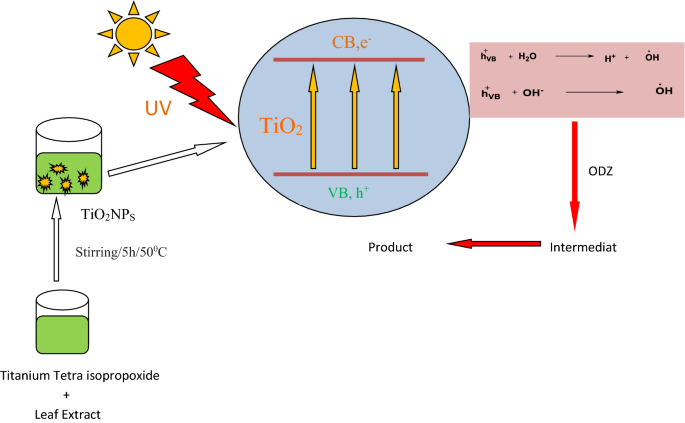
A photocatalyst (e.g., TiO₂, ZnO) absorbs light and generates electron-hole pairs that drive reactions:
- reduces species (e.g., , )
- oxidizes species (e.g., , organics )