Ball Milling
1. Introduction to Ball Milling
Ball milling is a mechanical processing technique used for grinding, mixing, and alloying of materials by using the impact and friction of balls (usually made of steel, ceramic, or tungsten carbide) inside a rotating cylindrical chamber.
Key Principle: Kinetic energy from moving balls is transferred to the material, causing fracture, deformation, cold welding, and/or chemical reactions.
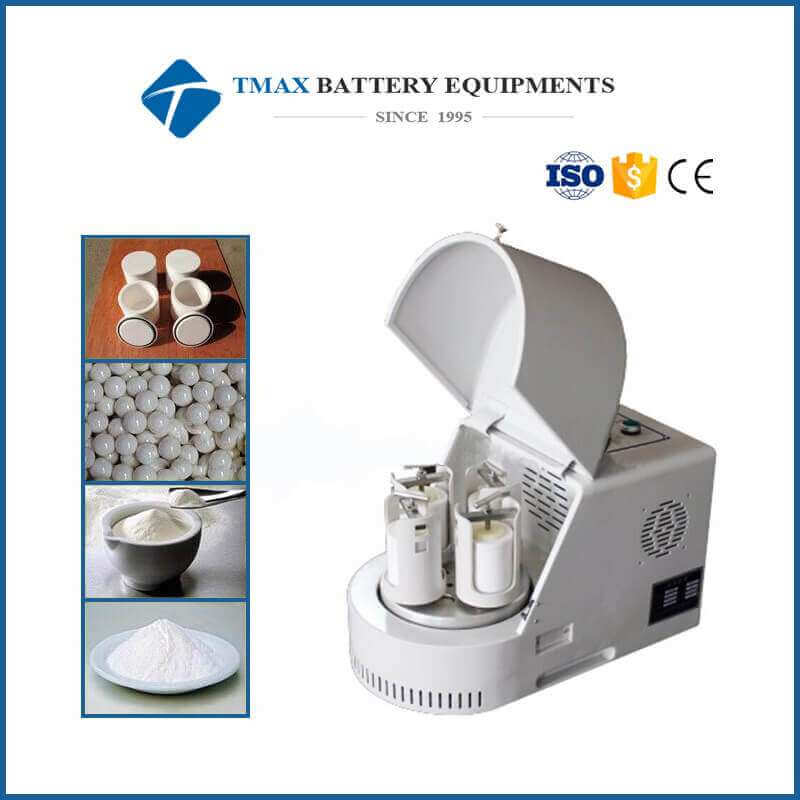
2. Fundamental Mechanism
2.1 Energy Transfer
- The mill rotates at a specific speed
- Balls are lifted to a certain height due to centrifugal force
- Upon reaching the top, balls cascade or cataract down
- Impact energy is transferred to the powder particles
2.2 Dominant Stress Types
| Stress Type | Description |
|---|---|
| Impact | Balls colliding with each other or the wall |
| Compression | Particles trapped between colliding balls |
| Shear/Friction | Sliding and rolling of balls over material |
| Attrition | Particle-particle interactions |
2.3 Critical Speed ($N_c$)
The speed at which centrifugal force equals gravitational force:

Where:
- g = gravitational acceleration
- R = radius of the mill
- r = radius of the ball
3. Types of Ball Mills
3.1 Based on Design
| Type | Description | Use Case |
|---|---|---|
| Planetary Ball Mill | Mill rotates on its own axis + around a central axis; very high energy | Nanoparticle synthesis, mechanical alloying |
| Vibratory Ball Mill | High-frequency vibration (~1200 rpm) | Small-scale, fine grinding |
| Attritor Mill | Stationary chamber, rotating impeller; high shear | Emulsions, fine powders |
| Tumbling Mill | Simple rotating drum | Low-energy, large-scale grinding |
| Roller Mill | Horizontal rotating cylinder | Industrial cement/mineral processing |
3.2 Based on Mode
- Dry Milling — No liquid medium; prone to agglomeration
- Wet Milling — Uses solvent or liquid; better dispersion, less heat generation
4. Process Parameters & Their Effects
4.1 Milling Time ($t$)
- Short time → coarse particles, incomplete alloying
- Optimal time → desired particle size, steady-state
- Over-milling → contamination, amorphization, unwanted phase transformations
Kinetics: Particle size reduction follows:

where k is the milling rate constant.
4.2 Ball-to-Powder Weight Ratio (BPR)
- Typical range: 5:1 to 20:1
- Higher BPR → Faster milling, finer particles, but more heat and contamination
- Lower BPR → Inefficient energy transfer
4.3 Mill Speed
- Low speed → balls roll, minimal size reduction
- Optimal speed → balls cascade (fall in a curved path) → highest impact
- High speed (above $N_c$) → balls stick to wall (centrifugation) → no milling
4.4 Ball Size & Distribution
- Large balls → high impact energy → good for coarse/hard materials
- Small balls → more surface contacts → good for fine grinding
- Mixed sizes → improves packing density, better energy distribution
4.5 Milling Atmosphere
- Inert (Ar, N₂) → prevents oxidation, contamination
- Reactive (O₂, NH₃) → enables mechanochemical reactions
- Vacuum → for highly reactive materials
4.6 Temperature
- Cryogenic milling → embrittles ductile materials, prevents oxidation
- Elevated temperature → enhances diffusion, solid-state reactions
5. Material Transformations During Ball Milling
5.1 Mechanical Alloying (MA)
- Repeated cold welding → fracturing → rewelding of powder particles
- Produces homogeneous alloys from elemental powders
- Key steps:
- Initial flattening of ductile particles
- Formation of composite lamellae
- Refinement of lamellar spacing
- True alloy formation (solid solution/intermetallic)
5.2 Mechanical Milling (MM)
- Processing of pre-alloyed or single-phase powders
- Changes: size reduction, amorphization, defect introduction
5.3 Mechanochemistry
- Chemical reactions triggered by mechanical energy
5.4 Amorphization
- Crystalline → amorphous transition when accumulated defects destabilize the lattice
- Critical defect density model
6. Mathematical Modeling of Ball Milling

7. Applications
7.1 Nanomaterials Synthesis
- Nanoparticles, nanocomposites
- Nanocrystalline metals (grain size < 100 nm)
7.2 Mechanical Alloying
- ODS (Oxide Dispersion Strengthened) alloys
- Supersaturated solid solutions
- Amorphous alloys (metallic glasses)
7.3 Hydrogen Storage Materials
- MgH₂, NaAlH₄ — improved kinetics via milling
7.4 Battery Materials
- Li-ion cathode/anode synthesis
- Solid electrolyte preparation
7.5 Magnetic Materials
- Hard/soft magnetic nanocomposites (e.g., Nd-Fe-B)
7.6 Catalysts
- High surface area catalysts via milling
8. Advantages & Limitations
Advantages
- Simple, scalable, low-cost
- Room temperature operation (mostly)
- Can produce non-equilibrium phases (amorphous, supersaturated)
- Applicable to all classes of materials
- Solid-state process — no solvent waste
Limitations
- Contamination — from balls, vial, atmosphere
- Broad particle size distribution
- Agglomeration — especially for fine, ductile particles
- Amorphization — may be unwanted
- High energy consumption
- Noise and vibration
9. Advanced Topics
9.1 Mechanically Induced Self-Propagating Reactions (MSR)
- Exothermic reactions triggered by mechanical impact
- Once ignited, reaction propagates through the powder bed
9.2 Shock-Induced Phase Transformations
- High-pressure phases (e.g., graphite → diamond)
9.3 Severe Plastic Deformation (SPD)
- Ball milling as an SPD technique
- Produces ultra-fine grained (UFG) microstructures
9.4 Scaling Laws
- Mill diameter $D$, critical speed
- Energy dissipation scales with ball mass × impact velocity squared
