Microemulsions
1. Introduction to Microemulsions
Microemulsions are thermodynamically stable, optically transparent, isotropic dispersions of two immiscible liquids (typically water and oil) stabilized by a surfactant film, often with a cosurfactant. They form spontaneously without significant energy input.
Key Distinction: Unlike macroemulsions (kinetically stable, turbid), microemulsions are thermodynamically stable — they form spontaneously and have infinite shelf life.
2. Definition & Key Characteristics
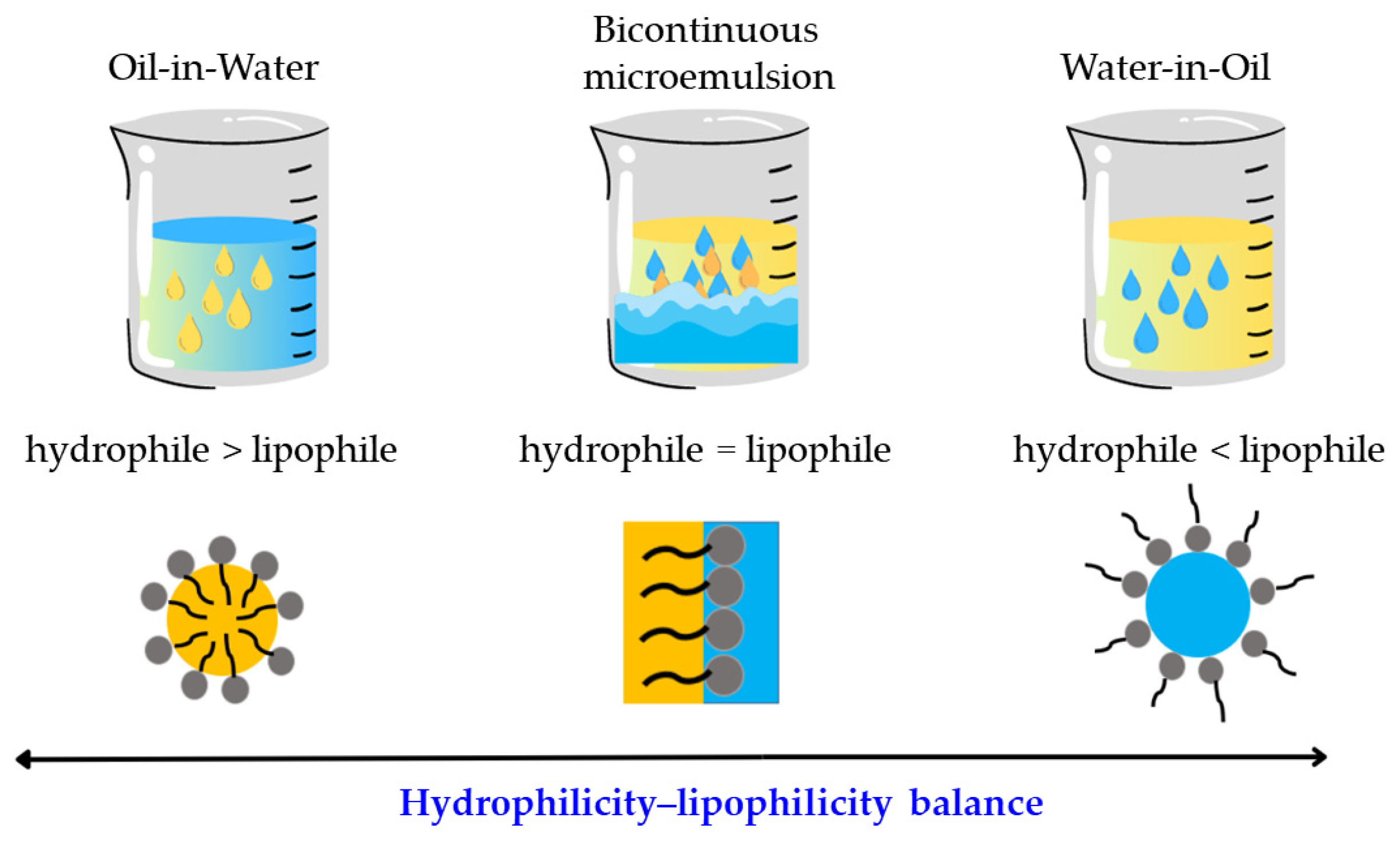
3. Types of Microemulsions
markdown4. Thermodynamics of Microemulsion Formation
4.1 Gibbs Free Energy of Formation
For spontaneous formation:
At ultra-low interfacial tension ():
The entropic gain from dispersing nanodroplets dominates over the small positive interfacial energy term.
4.2 Interfacial Tension
Microemulsions require ultra-low interfacial tension (10⁻³–10⁻⁵ mN/m):
Where = surface pressure exerted by adsorbed surfactant.
At sufficient surfactant coverage:
This is achieved when the surfactant film is saturated and the interfacial curvature energy is minimized.
4.3 Curvature Free Energy (Helfrich Model)
The bending energy per unit area of the surfactant film:
Where:
- = bending rigidity modulus
- = Gaussian curvature modulus
- = mean curvature ()
- = spontaneous curvature
- = Gaussian curvature ()
Spontaneous curvature ():
- → favors O/W (curved around oil)
- → favors W/O (curved around water)
- → favors bic