A ruby laser is a solid-state laser in which a ruby crystal acts as the active (lasing) medium. It was the first successfully demonstrated laser, developed by Theodore H. Maiman in 1960.
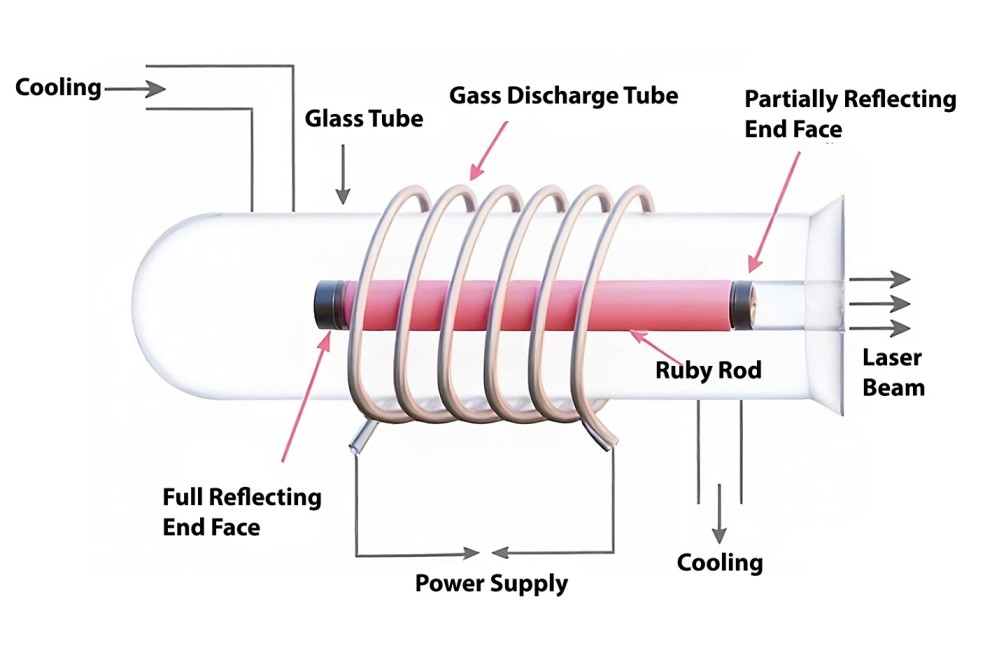
The active medium is a ruby crystal, consisting of:
doped with a small amount of chromium ions , typically about 0.05% by weight.
The ions are responsible for laser action.
Construction
A ruby laser consists mainly of:
Ruby rod – acts as the active medium.
Xenon flash lamp – provides optical pumping.
Two reflecting mirrors – form the optical resonator.
One mirror is fully reflecting.
The other is partially reflecting and allows the laser beam to emerge.
Power supply – provides high-voltage energy to the flash lamp.
The ruby rod and flash lamp are generally placed inside an elliptical reflector so that maximum pump light is directed onto the ruby rod.
Working Principle
Ruby laser operates on the principle of stimulated emission and is a three-level laser system.
When the xenon flash lamp produces intense light, ions absorb the pumping radiation and are excited from the ground state to higher energy levels.
They rapidly lose some energy through non-radiative transitions and reach a metastable state.
A population inversion is established between the metastable state and the ground state. When a photon of suitable energy passes through the medium, it stimulates an excited ion to return to the ground state, producing another photon of the same:
frequency,
phase,
direction, and
polarization.
Repeated stimulated emission produces amplification of light inside the optical cavity. A portion of this amplified light emerges through the partially reflecting mirror as the ruby laser beam.
4. Energy-Level Scheme

① Pumping (Optical)
Atoms are raised from the ground state to the broad pump bands A and B by absorbing light:
- Level B absorbs 4100 Å (violet-green)
- Level A absorbs 5600 Å (green-yellow)
These correspond to the strong absorption bands of chromium that give ruby its pink colour.
② Non-radiative decay to metastable level
From A and B, ions fall quickly and without emitting light to the metastable level 2 (releasing energy ΔE as heat to the lattice). Because the lifetime of level 2 is long (≈ 3 ms), a population inversion builds up between level 2 and level 1.
③ Stimulated emission (lasing)
Once inversion is achieved, a photon triggers stimulated emission from 2 → 1, producing the laser beam. The two closely spaced transitions give the characteristic doublet:
- 6943 Å (R₁ line) — the dominant laser line
- 6929 Å (R₂ line)
Comments
Post a Comment